
Autumn, the season of harvests and preparations
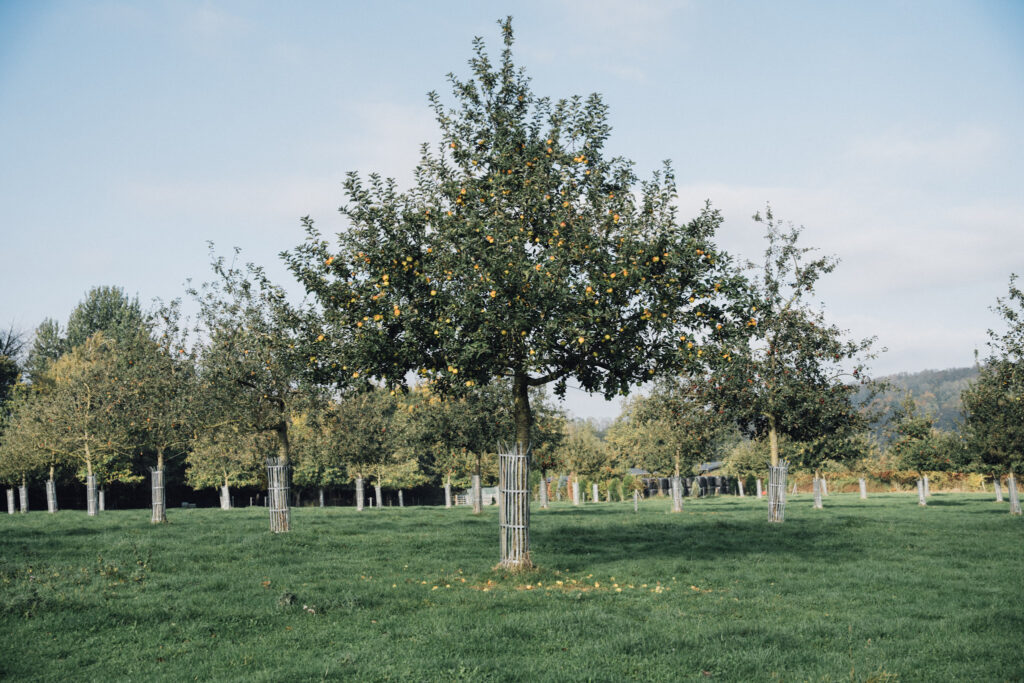
We cultivate a 6-hectare conservation orchard that maintains a wide variety of fruit trees. The trees grow in the orchard meadow without the use of chemicals, surrounded by our Angus cows, as part of our agroecological approach.
Conservation management of a high‑stem orchard
Conservation orchards preserve heirloom and local varieties of fruit trees. The orchard at Domaine de Graux, planted in 2011, is a traditional high-stem orchard. High stem refers to the height of the tree varieties. These varieties are rare as traditional high-stem orchards were gradually replaced by “low-stem” trees, which produce more standardized varieties that are more dependent on pesticides.
We use a modified central leader pruning method for the high-stem trees. The practice maintains a single dominant trunk but allows for well-spaced side branches, called scaffold branches. After a few years with this method, the orchard becomes more “low maintenance” and easier to manage.

Since the post-war “Green Revolution”, changes in farming methods and the industrialization of agricultural techniques led to the dismantling of orchards of nearly 95% of the orchards in Wallonia. Our conservatory orchard is a living resource that enables us to preserve the seed diversity of historical varieties and share these delicious fruits with consumers.
Domaine de Graux is part of the asbl diversifruit (an organization for the protection and guidance of conservatory orchards, or “hautes-tiges”). We also are working on certification for the “Verger Vivant” label, as part of the Vergers conservatoires network.
Beyond our production and conservation goals, our orchard aligns with the estate’s agroecological vision. Choosing pesticide-free, high-stem arboriculture helps preserve biodiversity and allows for grazing under the trees by our Angus cattle. This ancestral technique perfectly illustrates the “give-and-take” principle: the cattle benefit from shade and high-quality grass, while in return they maintain and fertilize the soil. Their manure contributes to the soil biology, supporting the diversity and abundance of soil microbial life and earthworms.
The advantages of high-stem orchards are numerous—both for an estate like ours and for the rural landscape in general:
- Carbon dioxide sequestration
- Structural diversity for the landscape
- A refuge for biodiversity, above and belowground
- Improved soil quality and rainwater infiltration
- Nutritional quality and flavor
- Agricultural diversification and economic value enhancement
Our estate has nearly 300 fruit trees. There are 129 apple trees of 54 different varieties, 38 plum trees of 8 varieties, 7 quince trees of 3 varieties, 20 cherry trees of 11 varieties, 52 pear trees of 21 varieties, and 50 walnut trees of a single variety. Here, an apple isn’t just an “apple”! Each one has its own flavor, texture, and specific uses from vinegar and brandy to compotes, syrups, and dried and fresh fruit.
Together with the CRA-W of Gembloux, we are working to confirm each of the tree varieties so we can share their history with visitors. Some of the unique apple trees include Gueule de Mouton, Transparente blanche, Belle-Fleur Large Mouche, and Court Pendue rose.

Pure orchard flavors
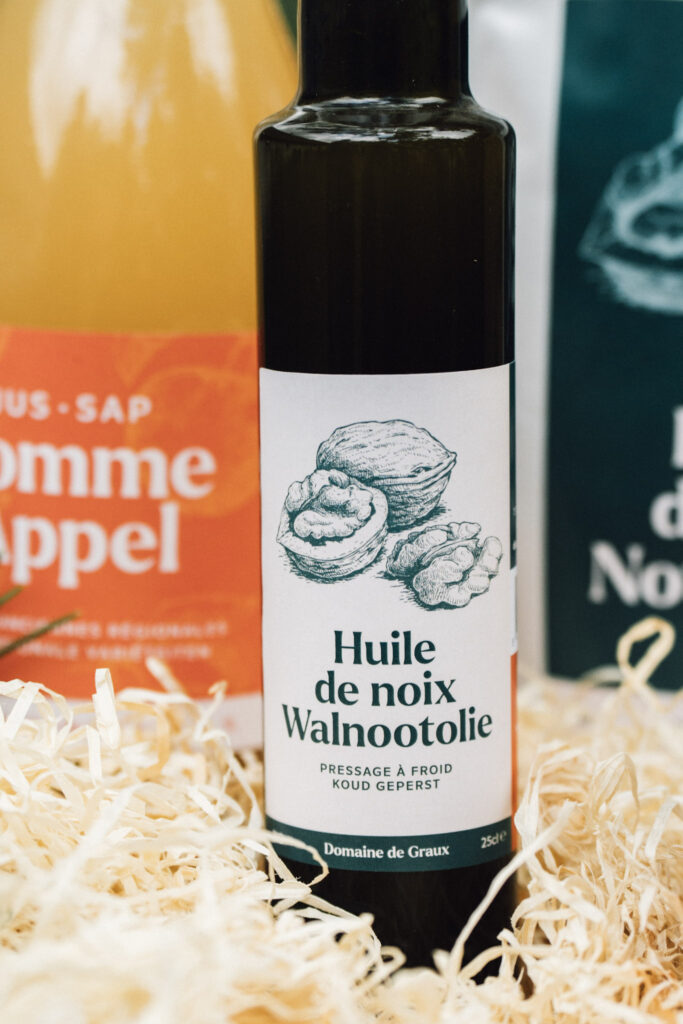
We produce artisanal jams made from plums from the estate. The different flavors are : Mirabelle, Prune de Prince, Belle de Thuin, Bleue de Belgique, and Reine-Claude. We also offer organic apple juice, pressed and bottled locally by Pom d’Happy. We also produce organic and gluten-free nut oils and flours made with our walnuts. The flours are made from the walnuts after pressing for oil. There is no waste. We are testing a new cider from this year’s apple harvest.
With the construction occurring at Domaine de Graux, we launched a partnership with Reinette & Co, a cooperative that coordinates the harvest, care, and development of the fruit. Together, we manage the orchard and market our products through their network, which allows us to introduce more consumers to old fruit cultivars.

The importance of biodiversity in the orchard
The variety of trees in the orchard is essential to support biodiversity of pollinator and bird species that pollinate our fruit crops and provide biological control for pests. In Autumn, we repair the nesting boxes that provide shelter for our bird allies. These actions help preserve the natural balance of our ecosystem, where each species plays an important role.
Every season presents different challenges, a natural alteration of abundance and rest for the trees. Last year’s rain stressed several trees. We will work with the conditions in that area of the orchard to replant varieties that best fit the soil and drainage conditions. Indeed, soil characteristics may vary from one plot to another.
This year, the climate helped as the spring blooms did not freeze. Thanks to the raptors and foxes, and the grazing Angus, our trees had less pressure from field mice. Our harvest was abundant. Every season, we learn to better care for this rich ecosystem by working with nature.
References
Graham, E., Grandy, S., Thelen, M., & Michigan State University Extension. (s.d.). Emerging issues in animal agriculture: Manure effects on soil organisms and soil quality. https://www.canr.msu.edu/resources/emerging_issues_in_animal_agriculture
Rayne, N., & Aula, L. (2020). Livestock Manure and the Impacts on Soil Health: A Review. Soil Systems, 4(4), 64. https://doi.org/10.3390/soilsystems4040064
Wyckhuys, K. a. G., Abram, P. K., Barrios, E., Cancino, J., Collatz, J., Fancelli, M., Klein, A., Lindell, C. A., Osterman, J., Pinto, M., Tang, F. H. M., Tena, A., & Elkahky, M. (2025). Orchard systems offer low-hanging fruit for low-carbon, biodiversity-friendly farming. BioScience. https://doi.org/10.1093/biosci/biae140