
May 22 marks International Biodiversity Day. And this year’s theme, “Acting locally for global impact” emphasizes the role of local initiatives in achieving global biodiversity. It’s the perfect opportunity to take a closer look at the work being done at Domaine de Graux.
But to understand why we’re taking action, we must first grasp the scale of what the world is losing.
A global challenge, local action
According to the latest WWF report (Living Planet 2024), between 1970 and 2020, animal populations declined by an average of 73%. In fifty years, we have thus lost nearly three-quarters of the world’s wildlife.In fifty years, we have lost nearly three-quarters of the world’s wildlife.
This figure is based on monitoring of more than 5,000 species of vertebrates, mammals, birds, fish, reptiles, and amphibians across the globe. This is not about species extinction, but about the collapse in the number of individuals within those populations. Populations are dwindling, silently, at an unprecedented rate.
The main cause ? Habitat loss and degradation, primarily due to our food system. These are followed by the overexploitation of natural resources, invasive species, and disease. It is these five major pressures cumulative and often simultaneous that are responsible for the biodiversity collapse observed worldwide.The main cause? Habitat loss and degradation, primarily driven by our food system, followed by the overexploitation of natural resources, invasive species, and disease. It is these five pressures, cumulative and often simultaneous, that are responsible for the biodiversity collapse observed worldwide.
In the face of this global reality, solutions exist. At Domaine de Graux, we have chosen to take concrete action, starting by understanding the true condition of our soils.
Regenerative agriculture at the heart of our approach
Certified organic since 2011 and B Corp certified since 2025, we are committed to a regenerative agriculture approach aimed at restoring soil health and promoting biodiversity on both our vegetable plots and our field crops. Our commitment: to produce organic products by working with nature, not against it.
Our approach is based on five principles: minimal tillage to preserve soil structure, no pesticides, creating natural spaces such as hedgerows, meadows, and ponds to enrich ecosystems, and maintaining permanent plant cover to protect and regenerate the land. Animals are integrated into a symbiotic balance with the various crops, and we also take care to conserve water and energy resources.
What makes this approach effective is that everything is interconnected. Earthworms and fungi bring the soil to life. Hedgerows shelter insects that protect the crops. Flowering meadows attract pollinators that sustain the orchard. Each element nourishes the others, and it is this balance that we strive to build, year after year.

Bees: A Reflection of Biodiversity at the Estate
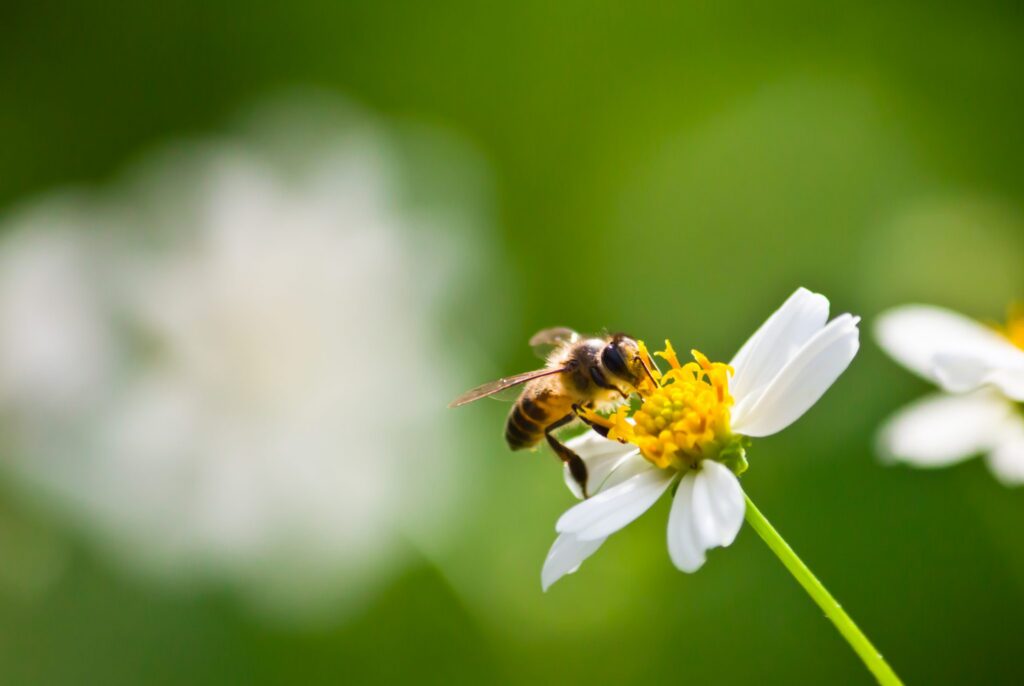
At Domaine de Graux, we work with BeeOdiversity, a company specializing in assessing, preserving, and improving environmental quality through wild bees. Their work enables us to identify more than 200 different plant species each year.
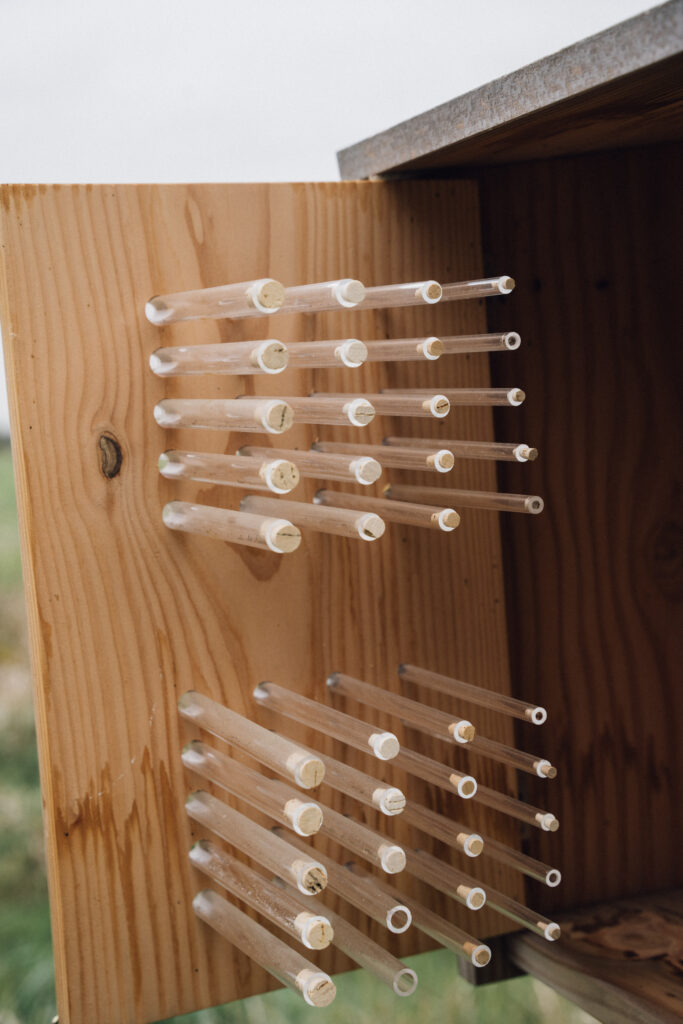
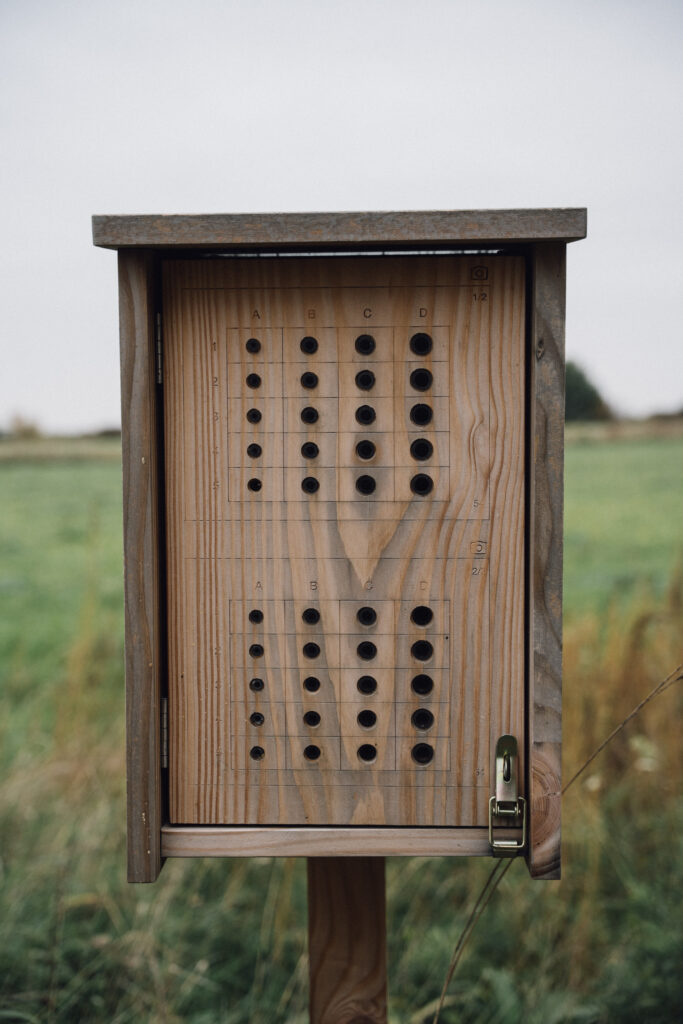
Since 2023, BeeOtels have been installed at the estate; these structures are designed to house various species of wild bees through tubes of varying sizes, tailored to their nesting needs. Wild bees are excellent bio-indicators, as their presence and activity directly reflect the health of the environment.
Thanks to the BeeOtels, we can therefore assess the health of our environment and monitor biodiversity. The bees also collect pollen from surrounding plants, which allows us to indirectly measure the plant diversity present around the Estate, as well as the potential presence of pollutants.
In 2025, we recorded above-average occupancy for nearly all tube sizes (and thus wild bee species), though there was a slight decline in activity during the summer compared to the spring, likely due to fewer flowering plants. As part of the BeeOmetrics project, BeeOdiversity also conducted soil and pollen analyses for the estate, which showed near-zero pesticide levels and below-average heavy metal levels.
Beyond Practices: Measuring Living Systems
To take this a step further, we enlisted the help of naturalists from Biotope Environnement, in the hope of establishing concrete links between our agroecological practices and the state of biodiversity on the site.
Their mission is to conduct a comprehensive inventory of habitats, flora and fauna, insects, birds, and bats, with observations carried out at different times throughout the year. The approach combines quantitative and qualitative analyses, as well as a comparison with control sites outside the domain.
This approach allows us not only to better understand the natural richness of Domaine de Graux, but also to measure the real impact of our practices. By tracking changes in biodiversity over time, we can identify what works, adjust what needs to be adjusted, and strengthen our contribution to a more vibrant and resilient ecosystem. The results of this study will be shared shortly.
The Health of Our Soils in a Few Figures
In 2023, we conducted soil analyses on several plots across the estate. Two key indicators were analyzed:
- organic matter (OM), which nourishes the soil, improves its structure, helps retain water, and stores the nutrients plants need to grow, and
- la biomasse microbienne (BMM, qui représente la quantité de micro‑organismes présents dans le sol (bactéries, champignons, etc).
These microorganisms break down organic matter, making nutrients available to plants and contributing to a living, fertile, and resilient soil.
The results show that the plots studied contained between 3 and 6% organic matter (OM) and between 15 and 30 µg of microbial DNA per gram of soil. These values are higher than normal, which generally range from 0 to 3% OM and 1 to 3 µg of MBM in conventional agriculture.
Birdhouses: An Ally for Biodiversity at the Estate
At the Domaine de Graux, birdhouses have been installed to provide homes for birds such as chickadees, robins, and owls. They true allies of the orchardare true allies of the orchard that naturally control pests and rodents. Each birdhouse is selected and placed according to the target species, to maximize the chances that it will settle there permanently. This is a concrete way to support local biodiversity while allowing everyone to observe wildlife up close.
Biodiversity: An Added Value for the Estate and Its Surroundings
What we’re doing here at the estate has an impact that extends far beyond our fields. By creating favorable conditions here, we’re helping the local flora and fauna thrive.
A pesticide-free orchard, hedgerows, flower-filled meadows, and well-placed birdhousesthese are all signals that attract and retain wildlife, these are all signals that attract and retain wildlife. And once established, it moves, reproduces, and colonizes neighboring lands. The Estate thus becomes a space where nature reclaims its rightful place.
Sources:
https://livingplanet.panda.org/living-planet-report-2024-key-messages